Essay // Literary Analysis: Dramatisation Through Characterisation in “Hard Times” (1854) by Charles Dickens

Charles Dickens’ Hard Times: “Have a heart that never hardens and a temper that never tires, and a touch that never hurts.”

CDickens

Hard Times is Charles Dickens’s tenth novel and follows his tradition as a social critic. Published in 1854, the novel is set in the fictitious town of Coketown during the Victorian industrial revolution. The story revolves around the constant struggle between fact and fancy, while Dickens treats us with characters that are comically characterized in multiple descriptive aspects in a – sometimes satirical – criticism of the social and economic pressure of his time. The story shows the impact of rigid aspects of life (upbringing, choices, circumstances and conditioning) on the characters that Dickens introduces in very dramatic situations – with images and dialogues in perfect tandem to deliver the near magical (surreal) effect he is known for treating his readers to. We will explore and analyse some of the key moments where Dickens uses characterisation before and after the climax in the dramatisation of his story and theme. The characters of Louisa, Gradgrind and Stephen Blackpool will be focussed on while particular attention will also be given to the rebellion against the utilitarian upbringing of a strict father, the blind preaching of fact, and the sad fate of a hard-working man struggling with a heavy drinking wife along with other tribulations of life.

Louisa is introduced to us in book one, “Sowing”, in Chapter 3, where she is caught peeping through the hole of a deal board by her father, Gradgrind. However, before the scene, we are introduced to Gradgrind and through Dicken’s physical portrayal of his character’s appearance, opinions and personality, we are dampened over the expected reaction of the strict father – especially over anything fancy – and in turn are more focussed on the reaction of the children. Louisa who will be focussed upon, is expected to have been fairly restrained throughout her upbringing; as before she is caught, Dickens gives an insight into the young Gradgrinds: “No little Gradgrind had ever seen a face in the moon; it was up in the moon before it could speak distinctly. No little Gradgrind had ever learnt the silly jingle, Twinkle, twinkle little star; how I wonder what you are! No little Gradgrind had ever known wonder on the subject, each little Gradgrind having at five years old dissected the Great Bear like a Professor Owen, and driven Charles’s Wain like a locomotive engine-driver”. (Dickens, 1995 p9)

While constantly following the theme of fact vs fancy, Charles Dickens uses a repetitive pattern with the “No little Gradgrind” adding a satiric sense which in turn adds to the feeling of mockery towards Gradgrind’s upbringing and his blind focus on facts. However, it also unveils early in the story, how the rigid conditioning of the hard man of facts was insufficient to completely smother Louisa’s inner sadness at not being able to enjoy the “fancy” side of life. Louisa described as “struggling through the dissatisfaction on her face, there was a light with nothing to rest upon, a file with nothing to burn, a starved imagination…” (Dickens, 1995 p11) comes as fairly expected in Dickens’ literature, while also giving us an insight in the children’s feelings; and judging from the outcome further in the story (where she nearly leaves Bounderby for James Harthouse), it tends to lead to the conclusion that the children have had to restrain so much (too much). Louisa’s short reply “Wanted to see what it was like” (Dickens, 1995 p11) gives us a hint about an air of rebelliousness about her character, a child eager to explore her emotions.

gradgrind

Another character, Thomas Gradgrind, whose role is pivotal to the plot; is also subjected to Dickens mockery. “’Now, what I want is, Facts. Teach these boys and girls nothing but Facts, Facts alone are wanted in life. Plant nothing else, and root out everything else. You can only form the minds of reasoning animals upon Facts: nothing else will ever be of any service to them. This is the principle I bring up my own children, and this is the principle on which I bring up these children. Stick to Facts, sir!’” (Dickens, 1995 p3) Once again, the repetition and focus on “fact” through direct speech gives us a clear description of Gradgrind’s character; however, as the story opens with those lines, we are also exposed to further characterisation which comes in the form of very caricaturesque physical descriptions of the character: “The speaker’s square forefinger emphasised his observations by under scoring every sentence with a line on the schoolmaster’s sleeve. /…the speaker’s square wall of a forehead, which had his eyebrows for its base, while his eyes found commodious cellarage in two dark caves, overshadowed by the wall.” (Dickens, 1995 p3) Both, the speech and the near surreal and comical physical description given by Dickens add to the dramatic effect accompanying Gradgrind as the story progresses. We are bound to tag these characteristics to his character from start to finish. Furthermore, the twist near the end is also dramatic, if not even slightly ironic, when the hard man of facts, Gradgrind is treated to his own medicine by Bitzer, who was brought up on facts and taught to operate according to self-interest.

In Chapter 8 on the 3rd book, “Garnering”, we see an extreme shift in Gradgrind’s behaviour when his son, Tom, is found out for robbing Bounderby’s bank; and is also being prevented to leave the country by a product of Gradgrind’s very own school of thought: Bitzer. Unlikely to his character, Gradgrind’s faith in his own methods failed when his own flesh and blood’s safety and future was at stake. “’Bitzer,’ said Grandgrind, broken down, and miserably submissive to him, ‘have you a heart?’ ‘The circulation, sir’, returned Bitzer, smiling at the oddity of the question, ‘couldn’t be carried on without one. No man, sir, acquainted with the facts established by Harvey relating to the circulation of the blood, can doubt that I have a heart.’ ‘Is it accessible,’ cried Mr Gradgrind, ‘to any compassionate influence?’ (Dickens, 1995 p220)

DETUD00Z

At this point, we are treated to further characterisation by Dickens, as Gradgrind’s deepest feelings are unveiled, and from the strong hard man of facts we had so far been accustomed to, to the man begging for mercy, Dickens set the tone for an unexpected turn of events in both the storyline and the change of “heart”. Furthermore, Bitzer’s response to Gradgrind is fairly satirical to us – if not darkly comedic – as his response is purely clinical and he answers in exactly the same way he answered Gradgrind at the very beginning of the story when he was asked to describe a horse: “’Girl number twenty unable to define a horse! /… ‘Girl number twenty possessed of no facts, in reference to one of the commonest of animals! Some boy’s definition of a horse. Bitzer, yours.’” (Dickens, 1995 p5) When Dickens creates the situation, Gradgrind’s dictatorial authority is showcased; his near religious bewilderment with facts is supported by Dickens’s comical characterisation, when the chapter is started with “Thomas Gradgrind, sir. A man of realities. A man of facts and calculations. A man who proceeds upon the principle that two and two are four, and nothing over, and who is not to be talked into allowing for anything over. /… with a rule and a pair of scales, and the multiplication table always in his pocket, sir, ready to weigh and measure any parcel of human nature, and tell you exactly what it comes to. /…You might hope to get some other nonsensical belief into the head of George Gradgrind, or Augustus… /…but not into the head of Thomas Gradgrind – no, sir!” (Dickens, 1995 p4). While we also find out the speech is usually delivered as an introduction to the public and friends. This unveils the utilitarian nature of Gradgrind and the type of model he sets for the children at his school; but it also points to the strict emotional suppression the latter lives by. The author here seems to have had the story planned, as such depth into the character of Gradgrind sets a strong image in the reader’s mind, and later (as mentioned earlier), the same Gradgrind – a man of facts – imploring the same Bitzer he (back in Chapter 2) who said “Quadruped. Graminivorous. Forty teeth, namely twenty-four grinders, four eye-teeth, and twelve incisive…” (Dickens, 1995 p5) to the question Sissy Jupe failed to answer. Gradgrind by his actions made Bitzer look like a hero, the same Bitzer who would coldly choose to jail the former’s son; while humiliating Sissy Jupe, the one who would provide an escape route for Tom.

Dickens in his own style of narrative elicits a change of feeling and opinion towards the characters as the story progresses. The dramatic effect at the end is the unexpected turn of events when Gradgrind chooses the way of “fancy”, a line of thought he rigidly objected against throughout much of his life. We are left to spectate the soft side of a man who is initially portrayed as a strict utilitarian who disregards any kind of emotion, but only acts on the rational and the calculated. The way he reacts to Bitzer when the latter refuses to give in to emotions is near comical but elicits pity from us. We see the constant theme of fact vs fancy reoccurring, but this time with the sides reversed when a man’s own flesh and blood is at the centre of all gloomy proceedings.

The wedding of Louisa to Bounderby is also a union devoid of feelings, but based on rationality and status. Dickens throughout the book points to problems of society but never claims the solution to be at the other end.
ht11

Stephen Blackpool, a man who had the choice to freely choose his partner is introduced in Chapter 10 of Book 1. Blackpool is introduced right after the author asserts his opinion about the hard working people of England. Once again, the tone and mood is set by the description of Coketown as an “ugly citadel” as we are placed in the set to feel the hardship Stephen Blackpool goes through as compared to the more affluent characters such as Bounderby and Gradgrind. The description of the “hands”, as the working class people of the times, is saddening with descriptions such as “lower creatures of the seashore, only hands and stomachs” (Dickens, 1995 p 50). This gives the feeling of Blackpool being used by the upper tier of society, and to soften our feelings for the character, Dickens goes on to explain how he looked older than his age, has had a hard life working in the factories and later we find out that he is subjected to the irrational behaviour of his alcoholic wife; a fruitless marriage that deteriorated. The combined misery of Blackpool sets an example of a good man totally mistreated by fate. The fact of not being able to be with Rachael (due to the marital limitations of the times), and dying horribly in the end. It seems like the imagery of the lower parts of town consuming the honest man that was Stephen Blackpool, as Dickens described the town as being “a town of unnatural red and black like the painted face of a savage.” (Dickens, 1995 p18) The negative characterisation of the industrialised city is also a clear indicator of one of the main subjects of Dickens’s disapproval.

The styles of characterisation in the building up of dramatic events is present throughout the novel, however Dickens keeps the debate of Fact vs Fancy as the main guiding thought. The characters are all presented as having their own dilemma to deal with no matter what their social rank and status, however, they are all placed meticulously and depicted precisely in Dickens’s style; which at times defies reality and pushes the audience towards the theatrical and/or the surreal; this works in synchronization with the characters actions and reactions, creating a well-balanced and well-paced plot where the themes of human deficiency – in actions mostly – is successfully portrayed along with interesting points such as fact vs fancy which remains unsolved, but leaves the audience in reflection – free to judge and relate to the characters flexibly and subjectively. Furthermore, the death of some of the “less appealing” characters along with some of the warmer ones, leads to a stale but thoughtful ending; with a near infinite number of morals over the “human” experience to ponder upon.

Bibliography

Main Source (Books/Textbooks):

Dickens. C (1995) Hard Times. Wordsworth Editions Limited, Hertfordshire (Click HERE to purchase from Amazon)

hardtimescover

Mardi, 22 Avril 2014 | Danny D’Purb | DPURB.com

____________________________________________________

While the aim of the community at dpurb.com has  been & will always be to focus on a modern & progressive culture, human progress, scientific research, philosophical advancement & a future in harmony with our natural environment; the tireless efforts in researching & providing our valued audience the latest & finest information in various fields unfortunately takes its toll on our very human admins, who along with the time sacrificed & the pleasure of contributing in advancing our world through sensitive discussions & progressive ideas, have to deal with the stresses that test even the toughest of minds. Your valued support would ensure our work remains at its standards and remind our admins that their efforts are appreciated while also allowing you to take pride in our journey towards an enlightened human civilization. Your support would benefit a cause that focuses on mankind, current & future generations.

Thank you once again for your time.

Please feel free to support us by considering a donation.

Sincerely,

The Team @ dpurb.com

Donate Button with Credit Cards

Climate Collapse & Human Extinction by 2030: it is real and it has started

Mis à jour le Jeudi, 20 Avril 2023

Climate Collapse Human Extinction dpurb site web

The horrific truth about a reality fast approaching is being discussed, with facts from various experts who have been keeping a close eye on climate change over the last century. If this video is deemed insufficient in raising awareness, then we are most probably doomed as primates on this planet, murdered by our own ignorance, stubbornness, indifference, and (I dare say it) sheer ignorant stupidity.

(You can find out more about Mathieu Rajchenbach videos here or follow him on Twitter @MRajchenbach

This is an issue that requires immediate attention. The simple observation that should get us all to react is:

FOSSIL FUELS ACCUMULATED OVER MILLIONS OF YEARS HAVE BEEN BURNT WITHIN A FEW CENTURIES. IT SEEMS LOGICAL THAT ITS EFFECT WAS GOING TO BE FELT IN A WAY OR ANOTHER. AND… THAT “WAY” IS GLOBAL WARMING and the increasing number of HORRIFIC and FLASH NATURAL CALAMITIES THAT HAVE TAKEN THE LIVES OF SO MANY UNSUSPECTING AND HELPLESS PEOPLE.

Les Voitures et les Emissions d'purb dpurb site web

Crédits : Philippe Lopez – AFP

For once, we can all get together and move our people globally and help save our only habitat: PLANET EARTH.

Less than half of the public are aware that scientists have agreed on Global Warming & human-related causes, not to mention the urgency for global action and renewable sources to power the planet, innovate & pave the way for a new era of planet friendly technology, lifestyle, ethics & society. (Click Here To Learn More)

BKuWwWKCUAAmOSu

Source: Twitter – @ConsensusProj // Website – TheConsensusProject.com

This requires immediate attention from all of us: all the movers & shakers who take up space in the head & hearts of the masses (and more importantly), the younger generation. It’s hard to imagine feeding most with a load of writing and statistic will work, but the power of ART has so far proven to reach and shatter barriers many other communicative techniques fail at.

WE NEED TO START TAKING ACTION NOW!!!!

We won’t see it coming, it’s a gradual process, until maybe [one fine day], waves mile high start swallowing entire cities within minutes. The rising temperature will also kill many organisms leading to the starvation of other species that feed on them [the circle of life].

05-24-human-extinction

It is vital that we start working towards GREEN ENERGY and COOL DOWN Planet EARTH together before it’s too late. All of us, violets, purples, blacks , whites, greens, yellow, oranges, mauves (etc), presidents, prime ministers, dentists, footballers, singers, actors, taxi drivers, carpenters, architects, journalists, presenters, gym instructors, lecturers, kitchen workers, drivers, parents, fathers, mothers, teachers, cousins, nephews, everyone… humans made of flesh, who would love to see a future generation live, breathe, smile and ensure the healthy evolution of the human race.

goute_deau_planete_terrePLEASE TAKE A FEW MINUTES, WATCH & SHARE (And try not to forget it all over a some mind-crushing episodes of some insignificant sitcom, or a few glasses of wine with a friend, we will all disappear… UNLESS IMMINENT action is taken! Some think it’s already too late)

(My rashness at times might suggest my ever-growing concern over the matter – which I apologise for)

Guy McPherson is a Professor Emeritus of Natural Resources and Ecology & Evolutionary Biology who chose to leave behind a life of academia and dedicate his work to saving our planet. However, his dedication alone will not suffice – we need to act, all of us RIGHT NOW. (The video below should be more than sufficient in convincing any leader (political to educational), and each & everyone of us [that CLIMATE CHANGE IS REAL AND SLOWLY EXTERMINATING LIFE ON PLANET EARTH, one species at a time]

(You can find out more about Guy McPherson’s writings and research through his website http://guymcpherson.com)

Should Guy McPherson’s video not sound convincing to the one’s who’d rather trust their “gut” instinct and feel that CLIMATE COLLAPSE is all a government scam to start generating tax money; or environmentalists are just a bunch of egomaniacs bent on proving a point; then the video below should clear all doubt.

The video below shows Daniel Crawford from the University of Minnesota who converted all the CLIMATE CHANGE DATA from the last 130 years (collected from NASA’s Goddard Institute of Space Studies). The conversion into a musical piece reflects what Guy McPherson and most environmentalists have been saying (and urging/begging authorities to take note) for the last century: THAT WE ARE PUSHING THE PLANET TO THE LIMITS OF GLOBAL ENVIRONMENTAL COLLAPSE.

And maybe it might be the struggle for survival that might unite us as the superior primates of earth and somehow incite us to re-evaluate the meaning (purpose) of existence. A lifetime well spent: What is it?

“I love my planet, and still have faith in humanity…”

By now I should think most of us would be convinced about the urgency of addressing climate collapse, yet if some want words even deeper and “realer” than real, below you’ll find one of the most honest, touching and real essays one might find from a scientist. It’s one from Guy McPherson’s “heart” and a scientist’s heart has so far rarely been one to write poems or love songs; yet this essay will address life, nature, purpose and the environmental importance & reality…

OLRONLY LOVE REMAINS by Guy McPherson

Extract:

“Most people would say I’m not religious. I’m not spiritually religious, although I exhibit some behaviors in a religious manner. I refer to myself as a free-thinker, a skeptic, and occasionally an indifferent agnostic or a militant atheist. So the apparently spiritual title of this essay would seem out of character for those who know me. I’ll not wander down the road of… “[CLICK TO CONTINUE READING]

Ma Nature danny d'purb dpurb site web

Danny J. D’Purb | DPURB.com

____________________________________________________

While the aim of the community at dpurb.com has  been & will always be to focus on a modern & progressive culture, human progress, scientific research, philosophical advancement & a future in harmony with our natural environment; the tireless efforts in researching & providing our valued audience the latest & finest information in various fields unfortunately takes its toll on our very human admins, who along with the time sacrificed & the pleasure of contributing in advancing our world through sensitive discussions & progressive ideas, have to deal with the stresses that test even the toughest of minds. Your valued support would ensure our work remains at its standards and remind our admins that their efforts are appreciated while also allowing you to take pride in our journey towards an enlightened human civilization. Your support would benefit a cause that focuses on mankind, current & future generations.

Thank you once again for your time.

Please feel free to support us by considering a donation.

Sincerely,

The Team @ dpurb.com

P.S.
– If you are a group/organization or individual looking for consultancy services, email: info[AT]dpurb.com
If you need to reach Danny J. D’Purb directly for any other queries or questions, email: danny[AT]dpurb.com [Inbox checked periodically / Responses may take up to 20 days or more depending on his schedule]

Stay connected by linking up with us on Facebook and Twitter

Donate Button with Credit Cards

Essay // Philosophical Review: Moral Relativism – Aren’t we all entitled to an ugly opinion?

Mis à jour le Mercredi, 28 Avril 2021Moral Relativism dpurb

No one system of morality is universal. But can we find a way to synchronise the world?

Educators believe the concept of right and wrong should be taught to children; yet, the concept itself has been challenged as to whose conception of right and wrong should be planted in the minds of the young. In this example, absolutists and relativist have been arguing the claim for choosing moral guidance. Could anyone (organisation or person) be entrusted as the arbitrator in morality? Is everyone meant to follow the same morals?

Ethical relativism is true per se – as no moral principles are valid for everyone. Anthropologists have made discoveries to back up the claim that different cultures have different practices and moral priorities and those which prevail in one does not necessarily have to be accepted in another. This argument tends to lean towards the descriptive explanation, where it is concluded that no one system of morality is universal; “what is believed to be morally good and bad differs from culture to culture” (Benn, 2006 p15) – meaning no system of moral is valid for everyone. Then, we have the normative side where codes of conduct could be assumed to be culturally determined. “Are certain things right for some cultures, but not for others – in the sense that the members of some cultures have certain obligations which members of other cultures do not have?” (Benn, 2006 p15) Ethical relativism, face another problem through other cynics who might claim that universal moral principles do exist. However, a major issue is raised here as the existence of such principles cannot be known; and the attempt to educate people morally may comes across as an extreme act of arrogance when the educators would be people just as morally fallible as the rest.

The doctrine has also been questioned in its addition to most debates. Does it even make sense? If it is believed that one should follow the moral principles imposed culturally, that makes no point in arguing the validity of other cultures, as one would have to first see the culture as authority. But this would close the debate uninterestingly. Therefore we look at the argument of cultural diversity where ­it takes the truth of the statement “no one system of morality is universally valid”. This leads to conclude the underlying assumption that some beliefs are false. Why can’t some people be wrong about their morality however strongly the hold to their conviction? An example to back the logic used is in other fields of science where many professionals disagree among themselves. A case that goes against ethical relativity is where morality is questioned by the individuals within the culture (after the assumption that each culture should comply with their respective prevailing opinions and morals).

The argument however is more complicated as the logic behind acknowledging culturally imposed patterns as “right” is heavily scrutinized by the Argumentum ad Nazium. This states the example of the Nazi culture that was clearly mistaken about “some” moral principles regarding human evolution and natural selection – policies that discarded assimilation and considered all non-Germans as inferior. Assuming that Germany had won World War II and applied Nazi policies and values over Europe and other areas, the question of whether their policies and values (i.e. human good emerges from conflict and domination) would then be deemed as good after they would have had settled as a culture seems conclusive. Surely, they would still be flawed in some aspects of their ideologies and policies even if they had their own culture.

The Nazi example clearly shows the flaw with ethical relativism because the consequence of some sections of its applied doctrines would have been a wrong understanding of human evolution, and hence, an erroneous interpretation and application of Darwin’s theory since it would have wrongly discarded the fundamental evolutionary principle of “natural selection” (assimilation) [See: Essay // Psychological Explanations of Prejudice & Discrimination].

Charles Darwin sur l'evolution par la sélection naturelle D'Purb Website

Traduction(EN): « I have called this principle, by which, each slight variation, if useful, is preserved by the term of natural selection. » -Charles Darwin / Note: Darwin devised the Theory of Evolution and was against bad breeding, and even supported a campaign to make marriage between cousins illegal due to the range of diseases and disabilities caused by consanguineous inbreeding [See: (1) Inbreeding, Consanguinity and Inherited Diseases(2) The Role of Inbreeding in the Extinction of a European Royal Dynasty, (3) Royal dynasties as human inbreeding laboratories: the Habsburgs & (4) 75% of Jews Are Lactose Intolerant and 11 Other Facts

However, in the 1930s, a tremendous amount of research on genetics was not yet carried out and perhaps if the Nazis had access to all the latest research of the 21st century, they would have rectified their policies based on good science after understanding that evolution encompasses all human organisms, since scientists have discovered 1,000 new “intelligence genes” [which is a highly heritable trait and a major determinant of human health and well-being] and have also found that 2 types of extroverts to have more brain matter than most common brains; this logically means that any talented individual organism with superior genes would be an asset to any group it assimilates into and passes down its genetic inheritance to, this would lead to the enhancement of the organic composition of the particular group. It is also to be noted that Adolf Hitler himself was the product of inbreeding between a man and his niece, the kind of breeding that Darwin himself would have been against since those inbred genes have the potential to pass down serious genetic diseases.

Hence, what “ethical relativism” seems to be promoting is tolerance; the idea of respecting the choice of one another. But is this acceptable in every scenario? Definitely not, because it could well be seen as confusion or moral cowardice when one is asked to withhold judgement from cases of extreme evil [e.g. “some” elements of Islam regarding the treatment of all non-Muslims termed ‘kaffirs’ (See: Essay // History on Western Philosophy, Religious cultures, Science, Medicine & Secularisation)].

wnr

In some locations on our small planet, strict behavioural patterns (culture) have been imposed on members of particular groups, rules grounded on authoritarianism (e.g. some countries under strict Islamic rules that many muslims living in the modern world themselves find irrational and excessive; countries where many voices who speak up against religious atavism and irrationality are often persecuted, jailed and even murdered sometimes). Such savagely imposed rules would surely leave the resident ethical relativist with a hard choice [if any] when expected to respect the “other” side’s approach to morality as a matter of giving every human being the freedom to choose their groups, sub-cultures, appearance & social patterns. However, these cultures have survived perfectly for generations [with dogmatism and other illiberal moral certainties] with a blossoming number of faithful to their restrictive lifestyle who are living within the confines of their political boundaries, where they are allowed to so as long as the choices of other countries, groups & individuals are respected. It would be fair to assume that the owner of a house is free to set out the indoor decorations, furnitures and rules but would be deemed as fairly unreasonable should he or she try to impose these personal rules in their neighbour’s home [who might prefer curtains to blinds, or fresh fruit juice over Pepsi]. Perhaps what ethical relativism is trying to elicit is toleration from all, but can complete control over human lives be compared to judgements on artistic tastes and decoration? Toleration has long been considered as morally virtuous. Yet, is it possible to be tolerant to others who strongly believe in “wrong” and who discard scientific facts, genetics and medicine? [E.g. legitimising marriage between cousins that promote genetic diseases?] Even from a religious perspective, some modern and evolving thinkers in the Christian faith see science as the systematic study of God’s works; Michel Langlois may have phrased it well in saying « Si Dieu nous a créés avec un cerveau, c’est pour qu’on s’en serve ! » [which is French for « If God created us with a brain, it’s so we can use it! ».

The moment we accept the notion that there is no absolute truth and that reality is a social construct that does not exist as such but that it is dependent on the perception and definition of the individual, we also open the door to the a great deal of the absurd, because we allow some groups [e.g. mediocre politicians, and other con artists] who have influence through departments that they control or other outlets, to use their conceived “reality” and impose it to maintain their power. In that sense, reality becomes a game produced by a particular questionable ideology, and so we can oppose it with another ideology deemed more sophisticated and progressive. Hence, the oppressed are also able to respond with their arguments of another reality; this gives way to an idealogical battlefield where different “realities” oppose each other, where one has to win. Noble debates based on sound and reliable science, allows us to rewrite biology, science and history – allowing us to annihilate every trace of an outdated history that is not truth but a social construction at the service of a particular group’s oppression and obsession with supreme dominance.

The other tragic side of the logic that truth and reality are a matter of perception, is that in some societies, it allows the dominant to impose their ideology on the weak. When those ideologies are based on superstitions from another age and when the groups supporting them have the advantage of number and force, we have a perfect combination for tragedy: we spectate the murder of the values of the intellectual enlightenment. In the West, in the academic world some religious groups by supressing all universal rationalism are extinguishing the sophisticated values of the enlightenment, which were acquired at a heavy price after fighting against religious fanaticism and obscurantism. Some social pathologies can lead to the destruction of civilised society. It is only through intellectual discourse that reality can be discovered and conceived for the betterment of human civilisation.

So far, the only universally working derivative from the relativism debate seems to be toleration. The problems that confront ethical relativism remain debatable issues with no perfect solutions. However, a strong backup for toleration comes from Simon Blackburn’s article where it came as conclusive that some arguments are pointless – such as arguing about one’s art preference in an art gallery. It might keep the debate calmer if people were to agree to differ. Or, maybe relativism is just a way of dealing with each other’s personal choices while still not being in full agreement: tolerance. A similar example would be Piers Benn’s mention of colour preference; where relativism could not determine the “degree of pleasantness” to show which colour was “better”; and no objective scientific test in a laboratory will ever manage to do so.

Gustave Cailleboteart - Fruit Displayed on a Stand 469

Gustave Caillebotte (Paris 1848 – Gennevilliers 1894), “Fruits à l’étalage

Artistic preferences related to colours and style is a decision that is highly personal, influenced by a range of subjective factors that elicit particular feelings that hold special and unique signifiances for a particular individual. Ethical relativism is extremely important as it has elicited toleration from many while tackling hostility among parties; however, it falls short in providing solution when faced with irrational parties and deluded politicians who consider their unfounded opinions and desires as the only valid agenda and outcome.

Ethical relativism reminds us all that freedom of choice would seem a rightful entitlement to every human being of the 20th century living on a modern and civilised planet. According to Kantians [Immanuel Kant’s adepts], the sole motivating factor for someone’s action should be reason, and should issue from their own rational deliberations [See: Essay // Psychology: The Concept of Self]. Moral relativism’s addition to the issues on morality seems vague, as – assuming that moral judgements are judgements of personal taste, like one’s artistic preference and taste for  a certain colour – it seems fair to conclude that the choice might be desirable for one but not for another. Yet, the logic of “good for one, bad for another”, can at times be misleading in morality. The example of colour blindness mentioned by Piers Benn seems to deliver concrete proof of how relativism remains a questionable doctrine. Assuming red-green colour blindness was on the rise, the majority would likely quality the affected as “seeing things differently” and not less correctly. This logic however is flawed when applied in other circumstances such as: if half of the population had a disorder that affected their orientation and ability to size objects, they would surely be causing severe injuries to themselves and others; in that case they would be considered as “wrong”.

The analogy of colour “seeing things differently” seems more adequate for morality in subjective matters of personal taste; however, that concept is unlikely to work globally in other domains because it also cancels out dialectical debates, and disregards disparities in factual, logical and philosophical reasoning, discursive, creative, managerial, intellectual and/or political skills which is an unrealistic outcome since the judgement of the mediocre majority of faillible humans is clouded by stubborn and selfish emotions that lead many to lie, deceive and misguide in order to stay in or get to power, especially in industrialised and mechanical societies that lack moral conscience and humane philosophies; third world countries where the level of education is poor; and some countries under strict religious laws that restrict intellectual and philosophical discourse, leading to a naive majority among their people, and hence an illusory and atavistic democracy that is simply the combined self-destructive voices of the naive and mediocre.

Sunday Art Fair London 2019

Image: Sunday Art Fair, Londres, 2019

Hence, the analogy of colour which simply views different opinions as “seeing things differently” is acceptable for philosophical arguments related to matters of personal taste, such as artistic preferences, but fails in matters related to the management of society because it would wrongly entice that each culture is right in its own choice, a concept that could allow unreasonable and insensitive political groups to create the illusion of a peaceful society where many have no other options but to suffer in silence – as we know from historical cases of political abuse [e.g. Idi Amin] in third world countries in Africa.

To conclude, the examples mentioned seem to bring ethical relativism to just a matter of adopting a tolerant attitude towards others in personal matters of taste, even if it goes against yours. While relativism does not seem to provide absolute solutions to debates related to the management of civilisation, it does help parties cope with their differences with an element of fairness: accepting the fact that judgements of personal taste & lifestyle differs from one individual to another – what may be deemed as ‘perfect’ to an individual may in fact be a horrific and torturous nightmare to others [who may even be in the direct bloodline, network, culture, nationality, class, IQ group, etc].

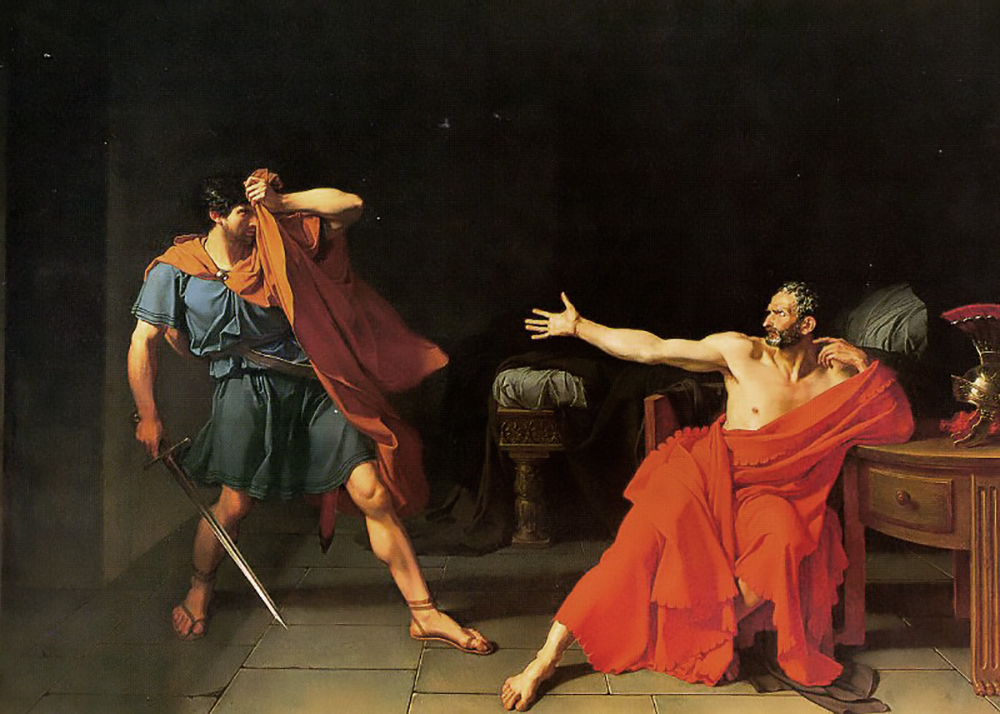
Drouais, Jean-Germain (French, 1763-1788)

Image: “Marius prisonnier à Minturnes” par Jean-Germain Drouais (Paris 1763 – Rome 1788) au Musée du Louvre

Reality has always existed and took civilisation from the prehistoric times to the modern world and reality evolves with knowledge and sophistication. Reality can only be known through debates which must be accompanied with the freedom that promotes free speech along with the ability to support opposing views and sometimes accept the superiority of another. It is this kind of open society that allows the respecful clash of ideas on the construction of a universal reality that will put an end to ridiculous ideologies that are not true, but are simply useful to some groups who use it to promote violence and impose an unreasonable power on others. As Charles Rojzman reminded in an essay in Causeur, Jules Romains during World War II said: « nous sommes payés pour savoir que la jeunesse d’un peuple s’empoisonne avec facilité, et qu’ensuite cela peut coûter cher, et à ce peuple, et à la civilisation générale. » [French for: “we are paid to know that the youth of a nation are easily poisoned, and that this can be costly both to that nation and to general civilisation.“]

Auditorium, site François-Mitterrand - Nicolas Gallon - BnF dpurb

Auditorium, site François-Mitterrand – © Nicolas Gallon – BnF


___________________________________________

­­­

Références

  1. Alvarez, G., Ceballos, F. and Quinteiro, C., (2009). The Role of Inbreeding in the Extinction of a European Royal Dynasty. PLoS ONE, 4(4), p.e5174.
  2. Benn P. (2006) Ethics. pp1-29. Cornwall: TJ International Ltd
  3. Blackburn S. (2002) Think Autumn. pp83-88
  4. Ceballos, F. and Álvarez, G., (2013). Royal dynasties as human inbreeding laboratories: the Habsburgs. Heredity, 111(2), pp.114-121.
  5. D’purb, D., (2021). History on Western Philosophy, Religious cultures, Science, Medicine & Secularisationdpurb.com essais
  6. D’purb, D., (2021). Psychological Explanations of Prejudice & Discrimination. dpurb.com essais
  7. D’purb, D., (2021). Psychology: The Concept of Selfdpurb.com essais
  8. Grodin, E. and White, T., (2015). The neuroanatomical delineation of agentic and affiliative extraversion. Cognitive, Affective, & Behavioral Neuroscience, 15(2), pp.321-334.
  9. Rojzman, C. (2021). Le relativisme, suicide de la raison. Causeur Société. Causeur.
  10. Savage, J.E., Jansen, P.R., Stringer, S., et al. (2018). Genome-wide association meta-analysis in 269,867 individuals identifies new genetic and functional links to intelligence. Nat Genet 50912–919
  11. Langlois, M (2020). “Si Dieu Nous A Créés Avec Un Cerveau, C’Est Pour Qu’On S’En Serve !” Interview De M. Langlois, Spécialiste De La Bible (CNRS/Collège De France). Science et Foi. [online] Available at: <https://www.scienceetfoi.com/interview-de-m-langlois-specialiste-de-la-bible-cnrscollege-de-france> [Accessed 11 August 2020].

And a nod to Garo. A for sparking the question.

Danny D’Purb | DPURB.com

____________________________________________________

While the aim of the community at dpurb.com has  been & will always be to focus on a modern & progressive culture, human progress, scientific research, philosophical advancement & a future in harmony with our natural environment; the tireless efforts in researching & providing our valued audience the latest & finest information in various fields unfortunately takes its toll on our very human admins, who along with the time sacrificed & the pleasure of contributing in advancing our world through sensitive discussions & progressive ideas, have to deal with the stresses that test even the toughest of minds. Your valued support would ensure our work remains at its standards and remind our admins that their efforts are appreciated while also allowing you to take pride in our journey towards an enlightened human civilization. Your support would benefit a cause that focuses on mankind, current & future generations.

Thank you once again for your time.

Please feel free to support us by considering a donation.

Sincerely,

The Team @ dpurb.com

P.S.
– If you are a group/organization or individual looking for consultancy services, email: info[AT]dpurb.com
If you need to reach Danny J. D’Purb directly for any other queries or questions, email: danny[AT]dpurb.com [Inbox checked periodically / Responses may take up to 20 days or more depending on his schedule]

Stay connected by linking up with us on Facebook and Twitter

Donate Button with Credit Cards